


From Fists To Pharaohs
Evolution Of The Human Measure
Without The Math Headache
If you look closely at this comparison, you’ll see that artists have been arguing about how to measure “humanity” for thousands of years. It’s like a historical version of “who wore it better,” but with grids and anatomy.
The Egyptian system (the earliest grid) was purely practical: they used the width of a clenched fist as their base unit. To the Egyptians, a standard human was exactly 18 “fists” tall from the soles to the hairline. It’s stiff, it’s blocky, and it’s why Pharaohs always look like they’re ready for a very disciplined boxing match.
Then the Greeks showed up and decided beauty was a numbers game. They ditched the fist and moved to the “Head Unit” (the Polykleitos Canon). By making the head 1/8th of the total height, they shifted from “measured blocks” to organic flow. This is where we get the grace and “idealism” that makes statues look like they’re about to walk off their pedestals and steal your lunch.
Finally, Da Vinci took the Vitruvian approach, proving that the human body is basically a geometry project. He mapped the body within a circle and a square, showing that your arm span is equal to your height. It’s the ultimate “Aha!” moment for artists—proving that nature has a built-in blueprint. Whether you’re measuring in fists, heads, or geometric shapes, the goal is the same: making sure your hero looks like a masterpiece and not a collection of misplaced parts.
Get Your Head In The Game
The Universal Artistic Yardstick
Without The Measuring Tape Tangle
Leave a Comment
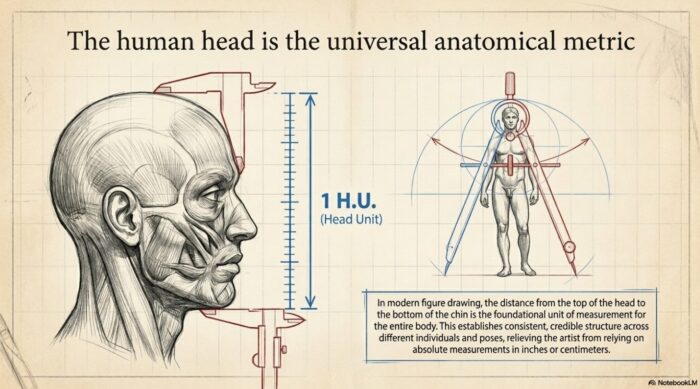
In the modern studio, we’ve traded the ancient Egyptian “fist” for something a little more cerebral: your own noggin. The Head Unit (h.u.)—measured from the top of your skull to the tip of your chin—is the ultimate vertical yardstick for the human body. Whether you’re stacking 7.5 heads for a regular human or pushing it to 9 for a “superhero” who clearly never skips leg day, this single unit keeps your anatomy from looking like a tragic accident at the mannequin factory. It’s the simplest way to ensure your character’s torso actually matches their shins, because let’s face it, nobody wants to draw a hero who looks like they’re perpetually standing in a very deep hole.

From Real World To Romantasy
Picking Your Perfect Height
Without The Pinhead Syndrome
Leave a Comment
In the real world, most of us are a respectable 7.5 heads tall—the kind of proportion that says, “I can reach the top shelf, but I also fit in a standard car seat.” But as artists, sometimes reality is just a bit… short. If you’re sketching that brooding Romantasy lead who spends his time staring intensely at misty moors, you’ll want to bump him up to the “Ideal” 8 heads. It adds that touch of noble grace that says he definitely has a six-pack under that tunic. And if you’re going full Marvel? Say hello to Thor at 8.5 heads. At this “Heroic” scale, the legs get longer, the chest gets broader, and the head starts looking dangerously small. Just remember: the taller the ego, the smaller the head unit!

The Tall Tale Of Three Gentlemen
Stacking Heads For Dramatic Effect
Without Creating A Mini-mind Monster Scale
Leave a Comment
Let’s be honest: in the real world, most of us are a modest 7.5 heads tall—the kind of proportions that say, “I’m here to buy milk and I’ll probably fit in the airplane seat.” But in the world of Romantasy, your leading man needs that “Ideal” 8-head boost to achieve peak smoldering-on-a-castle-balcony energy. If you’re drawing a literal god like Thor, you push it to the 8.5-head “Heroic” scale, where the legs are long, the chest is a fortress, and the head is tiny—the universal artistic code for “I can definitely bench press a planet.” Just remember to pick your height carefully; the taller the hero, the harder it is for them to find a pair of jeans that actually fit!

The Human Harp And The Gossiping Egg
Why Your Arms Are As Long As Your Legs
Without Looking Like A Crustacean
Leave a Comment
Ever tried to give yourself a high-five and realized your reach is surprisingly majestic? That’s because your total arm span is exactly equal to your height—nature’s way of ensuring you can reach the snacks on the top shelf. But the real secret to a believable torso is the “Inverted Egg.” Think of your ribcage not as a box, but as a large, upside-down egg. If you’re wondering where those pesky elbows belong, just look at the bottom of that egg shape. The elbow joints naturally rest right at the base of the ribcage, preventing your characters from looking like they have T-Rex arms or, worse, limbs that reach their ankles!